







Renewable Energy - Power
Author: Teri Kruger- juwi Renewable Energies (Pty) Ltd
( Article Type: Explanation )
Energy production in South Africa is mainly based on coal - a material that is finite and harmful to the environment and the climate. Whilst Nuclear is also used, this is not the best option given the recent failures in Japan and the very long-term hazardous materials storage requirement. Conventional energy sources are finite and increasingly expensive while, on the other hand, natural resources like biomass, hydro, geothermal, wind and solar are infinite and free of charge. The price of renewable energy technology is decreasing and advancements are showing greater efficiencies. In addition they add value locally by creating and safeguarding jobs, improving local infrastructure and increasing tax and leasing revenues. Thus, the future belongs to renewable energies. Accordingly, the SA Department of Energy has set a goal to generate 42% of electricity from renewable resources over the next 20 years.
Renewable energies are safe, reliable and profitable
Dependable, renewable energies have become a reality. The technology exists, the processes are tried and tested, and, there are countless success stories. Renewable energies are win-win all around: for the budgets of private landowners, authorities, companies and communities, as well as for the environment. Renewable energies are sustainable and profitable and it is important to recognise that they provide independence from imported raw materials originating in crisis regions.
Business case for 100% RE power production
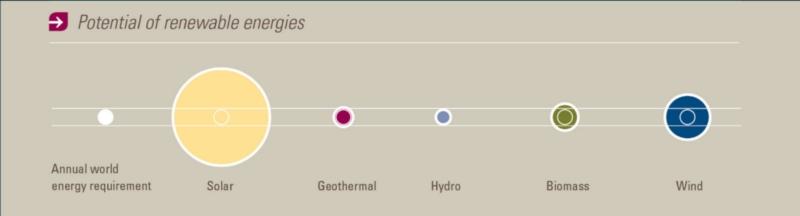
In the future, an increasing percentage of energy generation is going to be produced in smaller, decentralized generating stations, rather than large-scale power stations that pollute the environment. Many of these generating stations will use combinations of solar, wind and bio energy. An investment in renewable energy today is therefore no longer only for ideological reasons, but because the practical and economic reasons makes more sense than the old non-renewable technologies. Thanks to new and better technologies, renewable energy power systems continue to become more efficient and economical. Every day, the sun provides the Earth with more than ten thousand times the energy required by people around the world, and with the rapidly rising cost of electricity in South Africa, and decreasing cost of harnessing renewable energies, solar power can be produced close to a price parity with the older forms of power production.
Even in the colder countries like Germany, Photovoltaic (PV) plants produced more than 17,000 Megawatts in 2010; covering the annual need of approximately four million three-person households 100%. Converting from reliance on conventional to renewable energies can become a reality much faster than many people would expect. At good locations, wind power (and other renewable sources) can be marketed directly to local communities. This has the cost advantages of energy being produced locally with minimal transmission losses combined with the social advantages of increased local employment.
Emerging new industry showing growth worldwide
Renewable energy is a growing trend worldwide. Released in June 2011, the Greenpeace report, The Silent Energy Revolution: 20 Years in the Making, highlights how renewable energy power plants accounted for more than a quarter (26%) of all new power plants added to the worldwide electricity grid over the past decade, compared to nuclear power stations representing just 2% of new installations in the same period. Since the 1990s, installations of wind and solar grew faster than any other power plant technology. In fact, renewable energy expanded rapidly, to reach its biggest market share in 2010 and providing enough capacity to supply electricity to the equivalent of one third of Europe.